
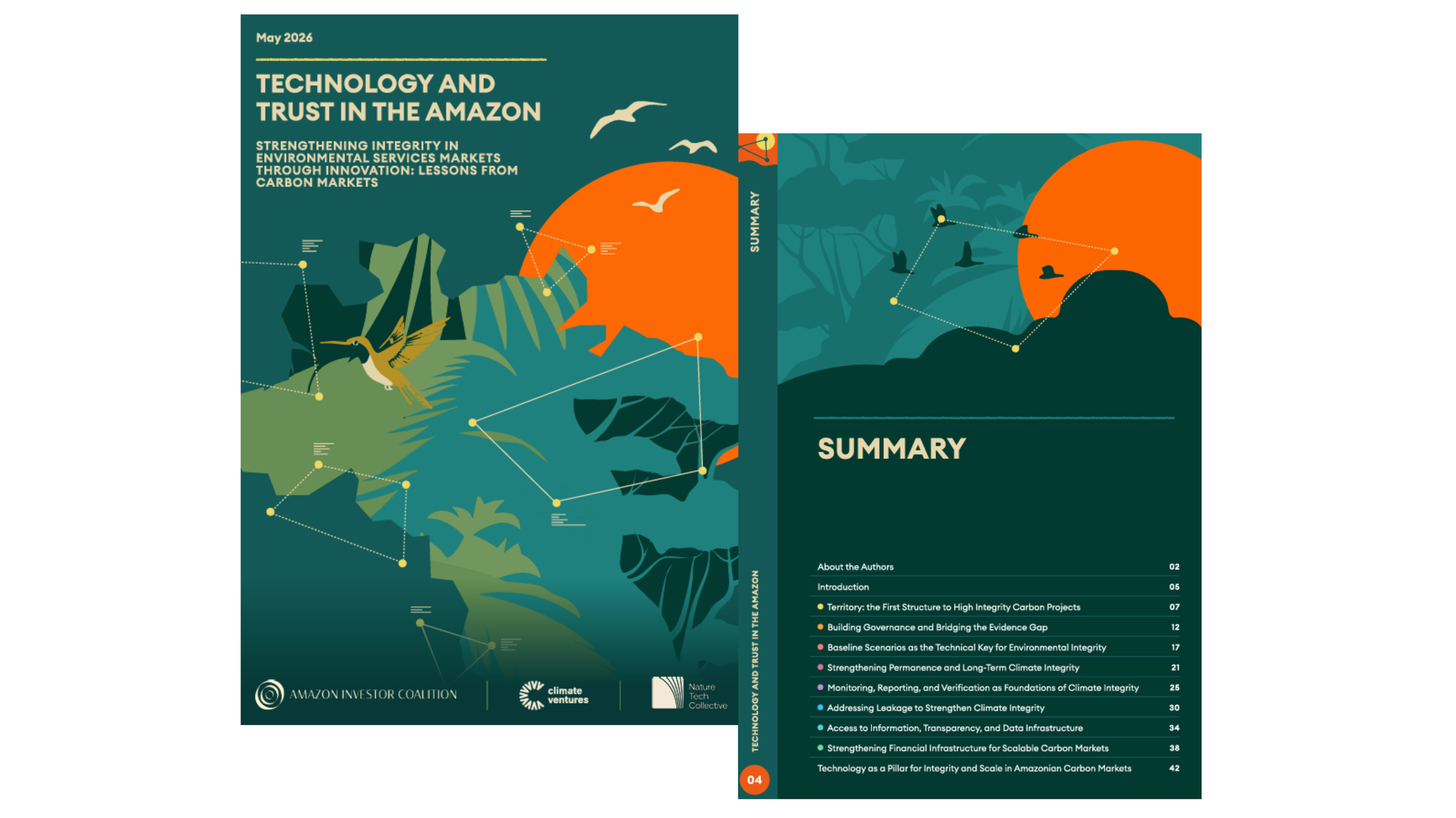
A new report from Amazon Investor Coalition, Nature Tech Collective, and Climate Ventures maps the growing ecosystem of technologies addressing the structural challenges that have undermined voluntary carbon markets and charts a path toward credible, scalable climate finance for the Amazon.
Voluntary carbon markets are at an inflection point. Nature-based solutions now represent 45% of total transaction volume in the voluntary carbon market, and the Amazon sits at the center of this story. However, the jury is still out on the best way to guarantee transparency for carbon projects. Moreover, years of scrutiny from academic studies to criminal investigations have exposed deep structural weaknesses that, left unaddressed, threaten to undermine the entire system.
The good news: a new generation of technologies is actively solving these problems. Our new report, Technology and Trust in the Amazon, maps this emerging landscape and explains how specific innovations are addressing the core integrity challenges that have held carbon markets back. We've combined this report with a table mapping further relevant technical solutions based on the Trust layer it addresses in the Amazon.
Seven Structural Problems, and What Technology Is Building to Fix Them
Problem 1: You Cannot Protect Land You Cannot Prove You Own
In the Amazon, land tenure is not a bureaucratic technicality. It is a foundational prerequisite for any carbon project. Ecological pressures such as mining and deforestation, combined with a lack of digital cadastral records, further complicate these tenure struggles. Without clear, legally valid, and uncontested rights over a territory, emissions-reduction credits can be challenged, invalidated, or turned into instruments of fraud.
This is not merely a legal problem. Inconsistencies between notarial records, environmental registries, and satellite data create a "cascade effect" of different certifiers adopting different methods, different developers using different databases, and results that are impossible to compare or verify.
The technologies solving it:
Uirapuru and Terranalytics integrate cadastral records, environmental registries, and geospatial data to reconstruct and systematize land tenure information at scale, enabling early detection of overlapping claims and tenure risks before a single field visit takes place.
Terras App brings together over 20 land-related datasets into a single analytical platform, combining satellite imagery, georeferenced data, and land registry information to support transparent territorial governance across legal, environmental, and land-use dimensions.
LandPrint Earth goes a step further by connecting land tenure, environmental compliance, and production-related data in an integrated system. This is critically important for identifying cases where formal title exists but does not reflect who actually occupies or governs a territory, a persistent problem in Improved Forest Management contexts.
Together, these tools transform territorial due diligence from a slow, tedious, and hard-to-verify process into a scalable, data-driven layer of analysis.
Problem 2: Baselines Are Built on Assumptions, Not Observations
The carbon baseline, or counterfactual, is the technical backbone of every carbon credit. It is also one of the market's most significant vulnerabilities. Studies have shown that methodological choices in baseline construction can cause estimates to vary by an order of magnitude across projects, creating incentives to select approaches that inflate credit issuance.
Because baselines are probabilistic models, not direct measurements, their accuracy depends heavily on the quality of data inputs, the comparability and monitoring of reference areas, and the frequency of updates. In complex, dynamic landscapes like the Amazon, where economic pressures, land-use policy, and social dynamics shift continuously, historical baselines quickly become outdated.
Technology is racing to catch up.
Tero Carbon, a Brazilian digital certification body, develops methodologies specifically calibrated to Brazil's territorial and productive realities, operating at smaller scales with shorter update cycles to reduce the distortions caused by overly abstract baselines.
Equitable Earth integrates social safeguards directly into baseline construction, adopting more conservative parameters and greater transparency around methodological assumptions, limiting the arbitrariness that has fueled overcrediting.
Emerging tools like geospatial embeddings, used by organizations such as Renoster with Google's AlphaEarth technology, create a forest "fingerprint" for each parcel by compressing and analyzing the interactions between multiple data layers, enabling more precise and defensible matching of control and project plots.
Problem 3: Governance Exists on Paper, Not in Practice
One of the most persistent failures in carbon markets is the gap between declared governance and implemented governance. Community consent and participation processes are documented but rarely tracked, verified, or made accessible in real time. The result is a market where buyers of ex post or ex ante credits cannot independently confirm that what was promised is actually happening on the ground.
This problem is particularly acute in community-based and Indigenous-led projects, where the credibility of governance is inseparable from the credibility of the credit itself. Without mechanisms to demonstrate continuous, legitimate participation, projects become vulnerable to conflict and scrutiny.
The technologies solving it:
Working Trees deploys mobile applications and georeferenced field records to document project implementation continuously, enabling evidence to be generated at the point of activity rather than reconstructed for auditors.
Savimbo, an Indigenous-led platform, allows communities to directly generate, manage, and monetize environmental data through decentralized governance structures, turning MRV from an externally imposed process into a community-controlled one, with direct links to financial flows.
Tô no Mapa and Mapeo by Awana Digital support participatory territorial mapping, enabling communities to produce primary data that reflects local land use, governance systems, and territorial boundaries from the ground up.
The Carbon Justice Standard operationalizes social integrity through a digital platform that continuously documents FPIC processes, decision-making, and benefit-sharing, moving beyond declaratory compliance to ongoing, verifiable evidence of governance in practice.
Problem 4: Permanence Is Assumed, Not Managed
Carbon credits sell the promise of long-term climate benefit. But forests burn, droughts intensify, and once financial incentives end, conservation outcomes can reverse. Traditional permanence mechanisms, including buffer pools and long-term commitments, are important but insufficient when monitoring is episodic and territorial threats are continuous.
In the Amazon, this challenge is compounded by a dynamic that adds a layer of complexity: deforestation in one area can disrupt rainfall patterns in neighboring regions, creating climatic feedback loops that threaten forest carbon stocks far beyond the original site of disturbance. Modelling this dynamic, as well as the socioeconomic pressures and other layers of pressure project areas may experience, is essential to issuing credits with a high degree of permanence.
The technologies solving it:
PrevisIA, developed by Imazon, applies AI and spatial modeling to forecast deforestation risk, identifying areas under emerging pressure before reversals occur and enabling preventive resource allocation.
ForestLink enables real-time community reporting of illegal activities, including chainsaw operations, land invasions, and encroachments, directly from remote areas to relevant authorities, dramatically shortening the response window.
Rainforest Labs supports continuous, community-generated data streams on forest conditions and land use, creating a locally grounded layer of territorial intelligence.
Rainforest Defense Company converts monitoring data and alerts into rapid on-the-ground enforcement, reframing permanence not as a passive methodological attribute but as the outcome of active territorial governance.
However, models and detection tools are only as useful as those responding to them. Here, we ought to look toward institutional and methodological changes that enable not only detection but enforcement.
Problem 5: MRV Is Periodic, But Forests Change Every Day
Monitoring, Reporting, and Verification is the technical backbone of carbon market trust. But traditional MRV has been episodic, document-heavy, and dependent on long audit cycles. This creates systematic information asymmetries: developers hold privileged access to operational data while buyers rely on filtered, periodic snapshots that are difficult to independently verify.
The technologies solving it:
Shamba Network deploys remote sensing, cryptography, and blockchain-based data oracles to ensure the integrity and traceability of climate data used in carbon accounting, transforming observable environmental information into verifiable, tamper-resistant records.
Rainforest Connection (RFCx) deploys AI-enabled bioacoustic sensors in forest canopies, continuously monitoring forest soundscapes to detect biodiversity patterns and illegal activities, including chainsaw operations, in real time. This provides a layer of independent, continuous verification that no periodic audit can replicate.
Re.Seed integrates field data, satellite imagery, and bottom-up mobile data collection to enable shorter monitoring cycles and real-time verification, particularly well suited to restoration projects where iterative, site-level evidence is essential.
Open Forest Protocol provides an open-source, blockchain-based MRV architecture where mobile field data is captured, validated through a decentralized network, and recorded immutably, creating publicly accessible, tamper-resistant audit trails throughout a project's lifecycle.
Regen Network enables the continuous recording and decentralized verification of ecological data, shifting verification from static reporting cycles toward dynamic, recurrent monitoring across the project lifecycle.
Sylvera's Biomass Atlas delivers annual, high-resolution forest biomass data across 30-meter resolution from 2000 to the present, enabling defensible carbon baselines and independent credit ratings, currently supporting jurisdictional REDD+ assessment in the Brazilian state of Acre.
Problem 6: Leakage Hides in the Supply Chain
Even a perfectly implemented project can fail if the pressures it displaces simply move next door. Leakage, the displacement of emissions-generating activities beyond project boundaries, is one of the most methodologically contested issues in carbon markets and one of the hardest to measure. Standard leakage factors applied uniformly across methodologies often lack empirical grounding, contributing to systematic overcrediting.
The technologies solving it:
AmaChains Carbon uses blockchain to track production flows and commodity movements across Amazonian value chains, making visible the economic dimension of land-use change and enabling the identification of indirect pressures on areas beyond project boundaries.
TransparenC is an AI-powered geospatial analytics platform that integrates satellite imagery and multiple data layers to generate real-time monitoring dashboards, transforming complex territorial data into accessible insights for identifying displacement patterns.
Problem 7: Carbon Credit Asset market is relatively immature
Even technically sound credits struggle to attract institutional capital when they lack the standardization, auditability, and financial interoperability that banks and investors require. For carbon markets to scale to the level the climate crisis demands, credits must function not just as environmental instruments but as investable assets.
The technologies solving it:
Climate Action Data Trust (CAD Trust) builds a global digital data infrastructure that integrates information across registries, methodologies, and certification systems using unique identifiers, directly preventing double counting and providing consolidated, auditable views of credit status across a fragmented market.
KLIMA Protocol goes further: through an on-chain bridging process, verified credits from established standards are locked at the source registry and re-issued as digital tokens, creating a unified blockchain environment where credits are priced, traded, and retired transparently.
Carbonplace provides digital market infrastructure aligned with international banking standards, enabling the trading, settlement, and custody of carbon credits within a single interface, reducing transactional friction and bringing carbon closer to conventional financial markets.
Triangle Digital builds digital twins of environmental assets, automating data collection and compliance to create carbon credits structured for use in financial instruments including sustainable loans and corporate reporting.
The Landbanking Group develops standardized, risk-oriented metrics for natural capital, including carbon, biodiversity, water, and ecosystem services, enabling environmental assets to function as verifiable collateral for credit, investment, and financing operations.
Sylvera also delivers independent third-party ratings of nature-based carbon credits, allowing investors to reliably assess and de-risk their carbon investments.
The Bigger Picture
These are not theoretical solutions. They are already being deployed across different segments of the carbon ecosystem in the Amazon. The report makes visible how they fit together: not as isolated tools but as a complementary technology stack, each addressing a specific failure point across the full lifecycle of a carbon project.
Read the full report here, explore the interactive ecosystem map to see how these tools fit together, and visit the Nature Tech Directory to add your organization.
Technology and Trust in the Amazon was authored by Ana Beatriz Freitas (Amazon Investor Coalition) and Owen Dehmler-Buckley (Nature Tech Collective), with contributions from Climate Ventures. April 2026.