
Why Some Farms Saw Almost Three Times the Yield Loss During the Same Drought
When drought hit France in 2023, not every farm saw the same losses. Early findings from a Soil Capital analysis, onducted in partnership with KU Leuven, drew on independently verified field-level data from 1,262 farms covering 331,600 hectares. In the area where the most detailed analysis was carried out, yields of the crop most affected by the drought fell by 22% on the least regenerative farms, compared with 8% on the most regenerative ones.
The analysis was observational rather than a controlled experiment, so it doesn't establish that regenerative practices alone caused the difference. Results also varied by crop type and farming environment, with some crop systems showing a weaker or no measurable resilience benefit. But across the wider dataset, the relationship between regenerative practice adoption and lower drought-related yield losses remained statistically significant even after accounting for factors including soil type.
A farm is more than the crops growing on it. Its condition, soil structure, the ecological features left standing, the inputs used to build and maintain it, shapes how it responds when drought, flooding, or other shocks hit. Much of this work has always been happening. We've just been far better at measuring what we put into a farm and take out of it than at measuring the ecological systems working in between, and better still at measuring outputs than at measuring the condition that produces them.
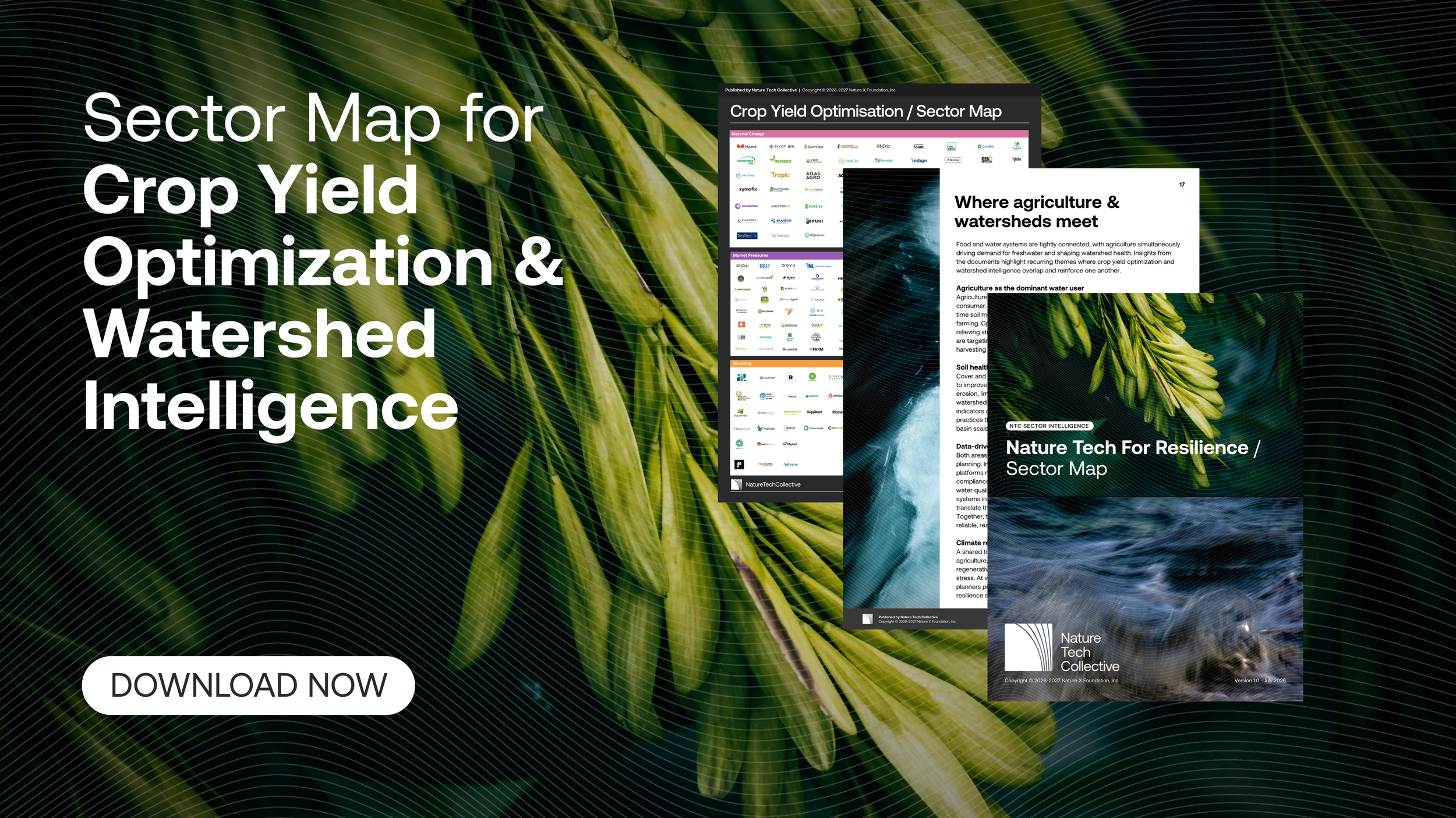
That gap is what our latest sector map set out to trace. For Nature Tech for Resilience: Crop Yield Optimization & Watershed Intelligence, we mapped 310 companies building technologies across two parts of the food-water system, 207 working on crop yield optimization and 103 on watershed intelligence. What emerged was a clear difference in where innovation is concentrated in each domain, and one gap both still share: crop yield optimization is most concentrated in Material Change, watershed intelligence is dominated by Measurement and Modeling, and Monetization is the smallest category in both.
Two parts of the same system
Agriculture and watersheds are often treated as separate problems, even though what happens on a farm and what happens in the watershed around it are tightly linked. Agriculture is the world's largest user of freshwater, so farm-level decisions ripple into rivers, aquifers, and wider catchments, while the condition of the surrounding landscape affects the water available to the farm in the first place. That connection shows up directly in the companies we mapped.
Crop yield optimization leans most heavily toward Material Change, the technologies and interventions that change what actually happens on the farm. That covers a wider range of approaches than it might first suggest, from restoring the ecological features a farm already had to introducing new biological inputs that work alongside existing operations, and the data shows a clear tilt toward the latter. Biofertilizers, crop supplements, and other biological inputs account for more companies than any other crop yield subcategory, likely because many of them slot into existing farm operations without requiring a grower to change crops or redesign their system. Pivot Bio's nitrogen-fixing microbials are a good example: the product colonizes crop roots and fixes nitrogen from the atmosphere, reducing the need for synthetic fertilizer without requiring farmers to change what they plant or how they operate. It's a different kind of intervention than restoring a hedgerow or a wetland, substitution rather than restoration, but it sits on the same continuum: both are ways of building resilience into the farm's underlying condition rather than just managing around it. That lower adoption friction may help explain why biological inputs are so prominent in this part of the landscape.
Other approaches ask more of farmers, since the resilience gains come with more friction attached. Cover and energy crops can improve soil, water retention, and resilience while creating new revenue opportunities, but planting, monitoring, and certifying them adds complexity, and the short-term returns can be uncertain. Spain's Moeve and CSIC are testing this model with camelina and carinata, grown as winter crops between food crops to supply advanced biofuels. The potential benefits go beyond a simple input substitution, but so does the route to adoption, which involves land eligibility, certification, and audit requirements rather than a straightforward product swap.
Watershed intelligence looks almost nothing like this. Almost three-quarters of the companies we mapped here sit in Measurement and Modeling, satellite data, sensors, flood and drought forecasting, catchment modeling, and decision-support tools. Where crop yield tech is mostly about changing conditions on the ground, watershed intelligence is still largely focused on understanding those conditions well enough to manage them.
You can't manage what you can't see. But seeing it isn't enough.
Across both crop yield optimization and watershed intelligence, Monetization is the smallest category we mapped, just 10.6% of the crop yield landscape and 6.8% of watershed intelligence. That doesn't mean there's no money flowing into these areas, it means relatively few companies are focused on the mechanisms that connect ecological outcomes to financial returns.
In crop yield optimization, certification and compliance remain complex, and relatively few solutions ensure farmers are consistently rewarded for outcomes like carbon storage. Watershed intelligence has the same issue in a different form: monitoring and analytics are advancing quickly, but few solutions connect improved water outcomes to finance or incentives. Between the two domains, we're building increasingly sophisticated ways to understand how healthy a given soil is, how much water a catchment has available, and where drought or flood risk is rising, but answering those questions turns out to be only part of the job, the harder part is what happens once we know.
More data isn't enough
The instinct when faced with environmental uncertainty is often to collect more data, and more data is clearly needed. The report maps a rapidly growing ecosystem of sensors, satellite platforms, modeling tools, and decision-support systems helping farmers, water managers, and planners move from reacting to crises toward anticipating them, but it also surfaces a second problem sitting right behind the first: measurement and monitoring tools are advancing faster than the systems needed to turn those insights into action.
Data sitting in one system can't protect a farm on its own unless something downstream actually changes because of it. A detailed soil assessment doesn't change a lending decision unless the lender can act on it, a watershed model doesn't improve resilience unless it changes how water gets managed, and a verified environmental outcome doesn't benefit the farmer who created it unless there's a mechanism connecting that outcome to revenue.
This is where some of the sector's biggest opportunities now sit: better interoperability between fragmented tools and datasets, compliance services that reduce the burden on producers, service-based models that combine technology with training and support, and stronger monetization pathways including crediting schemes, blended finance, and purchase commitments. None of these are as visually striking as a new satellite platform or sensor network, but they may matter just as much to whether the sector actually delivers on its promise.
From ecological signals to economic decisions
The bigger shift underway is about making ecological condition usable. The technology increasingly exists to monitor soil health, model water stress, and translate ecological condition into information about agricultural performance. What has lagged is the ability to turn those signals into something farmers, markets, lenders, insurers, and supply chain buyers can act on, which raises a real question: if two farms face the same climate pressures, but one has healthier soils, better water retention, and a more resilient surrounding landscape, should they carry the same level of risk in a lender's eyes? Nature tech is increasingly giving us the tools to answer that question, but making sure the answer actually changes something is the harder part.
The future of this sector isn't just about measuring nature more accurately. It's about connecting what we measure to decisions about how farms are managed, where capital flows, and who gets rewarded for building resilience. Our latest sector map looks at the 310 companies working across that landscape, from biological inputs and regenerative agriculture to satellite monitoring, flood forecasting, and catchment intelligence, and it shows where innovation is clustering, and where the infrastructure needed to turn ecological information into economic decisions is still underdeveloped.
If healthier soils, better water retention, or a more resilient landscape can reduce the impact of a drought, that value shouldn't remain invisible until after a crop fails. The opportunity for nature tech is to make it visible early enough for farmers, lenders, insurers, and supply chain buyers to act on it, and interoperability, compliance support, service-based delivery, and stronger monetization mechanisms are among the clearest ways to get there.
