
How Catawba College moved from a nature positive commitment to a site-level performance model, and why the measurement problem is harder than it looks
Overview
When Catawba College committed to becoming a nature positive campus, it had the usual starting point: good intentions, visible problems, and no clear way to measure whether anything it did was actually working. The Piedmont campus in North Carolina had large stretches of manicured lawn, practice fields that flooded regularly, and parking lots and roads draining fast into a nearby creek.
The college had made a serious commitment to becoming nature positive. What it did not have was a way to know what that meant on the ground, or where to start. Visible green interventions, pollinator gardens, native planting, composting programs, are easy to install and hard to evaluate. Without a way to measure whether the underlying ecological system is genuinely improving, a nature positive commitment risks becoming a collection of well-intentioned projects with no coherent direction.
What Catawba had, unusually, was a 120-acre biological preserve sitting directly adjacent to the main campus, largely intact, representing what that temperate broadleaf landscape should naturally be doing. That preserve became the benchmark. Working with EcoMetrix Solutions Group, the college built a detailed baseline of how the campus was ecologically performing across dozens of functions, mapped spatially and compared directly against the preserve as a local reference. That baseline is now feeding into a regenerative landscape master plan being developed by global architecture and planning firm HOK (Hellmuth, Obata + Kassabaum), who are using EcoMetrix's platform to test design scenarios before any ground is broken.
Why This Is Hard
Nature positive is a directional commitment, not a measurement standard. An organization can plant trees, restore a wetland, or reduce pesticide use and still have no clear answer to the question: is this place performing better ecologically than it was before?
The difficulty is partly definitional. Ecological performance is not one thing. A site can improve its carbon storage while doing nothing for biodiversity. It can support pollinators while worsening stormwater runoff. Knowing whether a landscape is genuinely moving in the right direction requires understanding dozens of interdependent ecological functions simultaneously, and understanding what those functions should look like in that specific place, in that specific biome. A benchmark imported from elsewhere tells you very little. What counts as good performance in a temperate broadleaf forest is not what counts as good performance in a desert shrubland.
It is also a data problem. The attributes that drive ecological function, including soil composition, vegetation structure, water regime, topography, and root density, cannot be read from a satellite image alone. Collecting them rigorously in the field is slow and expensive. Translating raw attribute data into a coherent picture of ecosystem performance requires modeling infrastructure that most organizations do not have and are not positioned to build.
For institutional sites like campuses, the challenge is compounded by the reality that these are working landscapes. They have to accommodate students, parking, facilities maintenance, and the expectations of a community with strong feelings about what the grounds should look like. Any intervention has to navigate that, which means knowing in advance which changes will move the ecological needle and which will not.
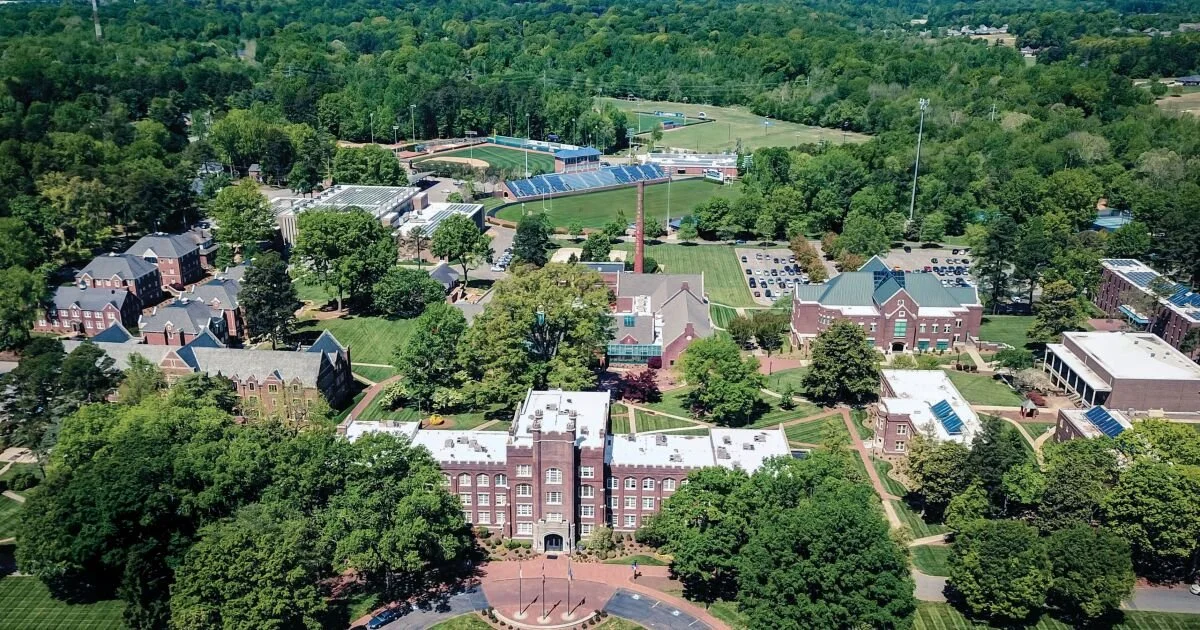
Image Credits: Catawba College
One Approach in Practice
A mowed lawn looks like open green space. Ecologically, it functions closer to pavement. High basal density means minimal water filtration. Without vegetation structure, there is no meaningful carbon storage, no biodiversity support, and if clippings are regularly removed, the soil is losing organic matter rather than building it. The gap between appearance and performance is what EcoMetrix was designed to address.
The platform, called Ecosystem Intelligence, works from the bottom up. Field teams survey the site and record the physical attributes that determine whether ecological functions are performed: vegetation structure, soil type, organic content, topography, water regime. Those attributes feed into a set of models describing the ecological processes they support, including infiltration, canopy interception, carbon storage, pollination habitat, and air filtration. Those processes in turn combine to produce ecosystem services, the tangible outcomes a site is capable of delivering, such as stormwater management or biodiversity support.
The output is spatial. Survey units are drawn across the site based on relative homogeneity of attribute distribution, often following vegetation structure or slope. Each unit receives a performance score for each function. The result is a set of heat maps showing where the site is performing well and where it is not, at a granularity that can support real planning decisions.
At Catawba, those performance scores are benchmarked against the adjacent forest preserve. The campus baseline is compared directly against the preserve across categories including soil health, water quality, water quantity, air quality, biodiversity, climate, and human health and wellbeing. The unit of output is a functional acre: a measure that combines quality and quantity. A ten-acre site performing at eighty percent of its natural potential produces eight functional acres of ecological benefit. That framing gives the output a common unit that works across disciplines, for a facilities director, a landscape architect, and a sustainability lead looking at the same map.
The initial analysis confirmed what the college already suspected about water. Clay soils, extensive impervious surfaces, and compacted monoculture lawns give stormwater almost no opportunity to infiltrate, slow down, or filter before it reaches the creek running alongside the campus. The analysis also showed that the campus, taken together with the preserve, performs considerably better than the campus alone, making visible exactly how much ecological work the preserve is doing and what might be possible if some of that function could be rebuilt on the campus side of the boundary.
The scenario modeling is where that possibility gets tested. HOK is using the platform to run design options against the baseline and reference scores before committing to any of them, identifying which interventions in which locations produce meaningful gains across the priority functions. Preliminary HOK scenarios have shown some areas of the campus approaching the biome reference level of performance.
One smaller example illustrates the diagnostic logic in practice. A pollinator garden already installed on campus was modeled and found to be underperforming. The diagnosis pointed to a lack of downed wood. Logs and sticks on the ground create nesting habitat for ground-dwelling invertebrates and contribute to soil processes, but facilities staff had been removing them as standard maintenance. Adding downed wood back to the garden and rerunning the model produced a measurable, if modest, improvement in performance. The point was not the downed wood itself. Routine maintenance decisions shape ecological outcomes, and without a model, there is no way to know which ones matter.
"We can't just give it up and say it's urban, we're not going to have any performance there. We need to eke out any performance we can get from every square foot of the globe at this point."
Kevin Halsey, Co-founder, EcoMetrix Solutions Group
What This Enables and Where It Falls Short
The most significant thing this approach enables is the ability to test before committing. Rather than designing a landscape intervention and hoping it performs ecologically, HOK and the college can compare scenarios against a defensible local reference and concentrate resources where the evidence suggests they will have the most effect. For a campus managing approximately $100 million in concurrent capital projects, integrating ecological performance into design decision-making before construction begins has direct financial as well as ecological value.
The approach also gives different disciplines a shared frame of reference. Sustainability staff, facilities teams, landscape architects, and college leadership can look at the same heat map and have a concrete, spatially grounded conversation about where the campus stands and what different interventions would do. In practice, those groups rarely start from the same place, and a shared visual output changes that conversation.
The limits are real and worth naming. The project is mid-stream. No scaled interventions have been completed and assessed through the full modeling cycle. The evidence base consists of a baseline comparison, preliminary HOK scenario outputs, and one small pollinator garden example. The platform's ability to drive measurable, campus-wide ecological improvement has not yet been demonstrated at Catawba, which is simply where the project stands.
Data collection remains a significant constraint. The platform's outputs are only as good as the attribute data going in, and collecting that data at appropriate resolution is labor-intensive. EcoMetrix currently bins data into ranges to ensure consistency across different field collectors, which limits output resolution. The team is exploring AI-assisted observation to reduce that constraint, but it is not yet operational.
The modeling infrastructure represents twenty years of accumulated work, with ecological relationships captured in Bayesian networks. That depth is a genuine strength in terms of output quality. It also means organizations using the platform are dependent on EcoMetrix for the modeling layer. Finally, the platform produces functional performance outputs, not monetary valuations. Translating ecological performance into financial value requires additional expertise and sits outside the scope of what Ecosystem Intelligence currently provides.
What Others Can Take From This
A local reference changes everything. Catawba's forest preserve is not just a conservation asset. It is a calibration tool. A benchmark grounded in what the actual biome on that actual land should be doing is worth far more than a generic standard applied from elsewhere. Organizations working on nature positive commitments should ask early whether a credible local reference exists and whether it can be incorporated into their measurement approach.
Model before you build. Running design options through a performance model before committing resources reduces the risk of investing in interventions that look ecologically meaningful but do not move the key metrics. For large institutional sites managing multiple concurrent projects, that capability has direct financial as well as ecological value.
Maintenance practices are ecological decisions. The downed wood finding from the pollinator garden points to something broader. Ecological performance is often constrained not by what is absent from a site but by what is being routinely removed. A modeling-based diagnostic can surface those constraints in ways that visual assessment alone cannot.
Communicate benefits beyond the boundary. Stormwater managed on campus does not reach the creek downstream. Framing ecological investment in terms of where its benefits are actually experienced, not just where the work is done, gives institutional landowners a stronger argument with communities, regulators, and funders.
This is one approach, not a template. The EcoMetrix platform is built on significant proprietary modeling infrastructure developed over two decades. Its application at Catawba is also shaped by an unusually strong fit between the college's values, an adjacent reference ecosystem, and a long-standing working relationship between the two organizations. Those conditions will not always be replicable. The principles underneath them can be: measure against a local reference, test scenarios before committing, treat maintenance as an ecological variable, and map where benefits land.
Case Classification:
Modeling · Measurement & Monitoring · Ecosystem Performance · Scenario Analysis · Bayesian Modeling · Temperate Broadleaf Forest · Institutional Landscapes · Nature Positive Planning
