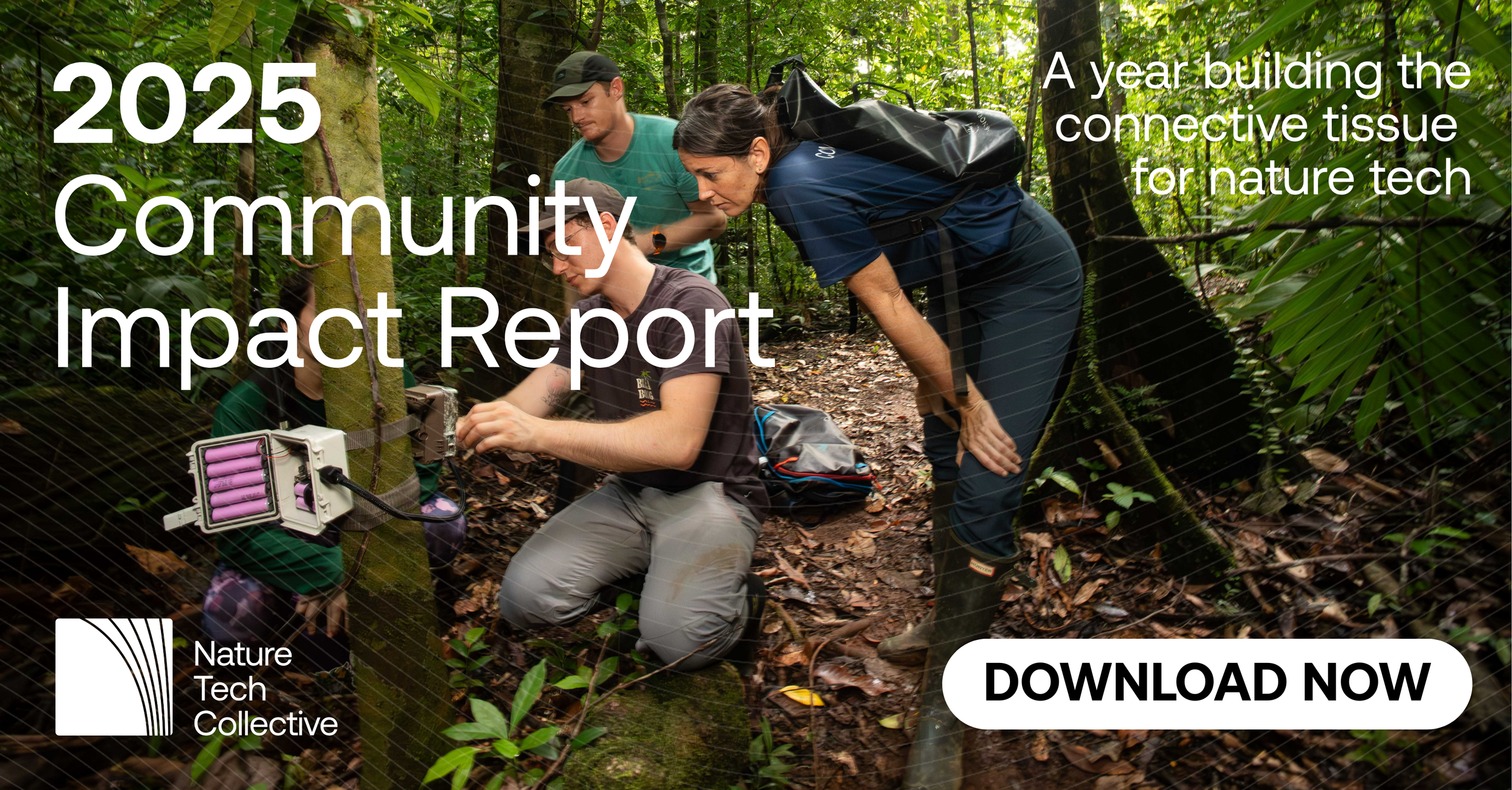
2025 Community Impact Report: Building Infrastructure for Nature Tech
One year after our first Impact Report, we're proud to share our 2025 Community Impact Report, a year defined by building navigational infrastructure for a market struggling to connect supply with demand.
We mapped 900+ organizations across three major sector map releases. We gathered 600+ practitioners at the first-ever Nature Tech Week. We launched a Nature Tech Directory prototype with 400 beta users. We reached 10,000+ professionals through monthly programming and amplification.
This report captures both our momentum and our learning edges: the infrastructure we built, the experiments that worked, the formats that flopped, and what we're committed to in 2026.
How we got here
Nature tech sits in a strange position. It's simultaneously inevitable and nascent, urgent and underfunded, technically sophisticated and struggling for market legitimacy.
The gap between what's technically feasible and what's economically viable remains vast. Innovation exists, but adoption lags. Technology providers can't find buyers. Buyers can't navigate hundreds of solutions. Investors want deal flow but lack sectoral fluency.
Our role has been to act as acupuncturists within this system, applying pressure at strategic points to help things flow.
What 2025 looked like
Today, the Nature Tech Collective brings together 187 members across the nature tech spectrum: solution providers, project developers, corporates, investors, and researchers, convening under shared purpose.
In March, we convened the first-ever Nature Tech Week. Over three days, 600 people gathered across three complementary events. The Nature Action Dialogues (March 25-26), run with UNEP-WCMC, brought together corporate leaders grappling with regulatory frameworks, supply chain dependencies, and biodiversity risk. The Nature Tech Summit (March 27), with CE Media and Nature 4 Climate, explored how technology is enabling practical nature action across risk management, regulatory compliance, and supply chain transparency. The Unconference (March 28) at London School of Economics was our most radical proposition: practitioners possess collective intelligence no curated program can match. No panels, just community-prioritized sessions and collaborative problem-solving. Each event capped at about 200 people: small enough for genuine conversation, big enough to span the ecosystem.
We published three major sector intelligence reports mapping 400+ organizations. Our Nature Fintech Sector Map mapped 200+ organizations and organized the landscape through a 5M Framework. The Biodiversity Monitoring Sector Map covered 600+ organizations spanning eDNA, bioacoustics, camera traps, remote sensing, and digital twins, searchable by region, framework alignment, and biodiversity focus. Our Forestry MRV Sector Map mapped 111+ organizations navigating the transition from carbon-only to comprehensive ecological monitoring. These publications reduce information asymmetries, accelerate partnership formation, and surface market gaps.
We launched the Nature Tech Directory as a prototype with 400 beta users. The problem it addresses is clear: hundreds of nature tech solutions exist, but there's no clear way to find what you need for your specific situation. The prototype lets people filter solutions by biome, technology type, and impact area. We're being honest though: the filtering isn't perfect, the user experience needs work, and we're still fine-tuning verification processes. With Member and Partner, Impact Labs, we're building toward framework mapping (TNFD, GRI, SBTN, SDGs), detailed features for comparison, and case studies that build trust. With Earth Genome and Conservation International, we're supporting Eco: an AI powered search tool that understands plain language queries. Both are prototypes that need work. We could wait until everything's perfect, but that would take years and remove precious opportunities for feedback and connection.
Our monthly programming maintained momentum between larger events. We ran 4 Demo Days with 200+ participants seeing real demonstrations, not sales pitches, organized around challenges like how to monitor complex ecosystems, turn raw data into decisions, and measure comprehensive impact. NTC Now became a year-long learning program across 17 sessions that educates the ecosystem and makes expert knowledge searchable, reaching 10,000+ professionals through live sessions, recordings, blog posts, and social content.
We tested Reality Check, 2 intimate mentorship circles where experienced practitioners give founders honest feedback on their strategies and market assumptions. Nature Tech Collective’s member, Amal Ketata from Nui led 7 webinars focussed on ocean tech gathering 500+ participants, focusing on innovation, capital access, policy, and connections. We showed up at London Climate Action Week, New York Climate Week, and Bloom, hosting working sessions, launching the Directory publicly, and running closed-door workshops. An experimental matchmaking format at Bloom didn't work as planned, but members made valuable connections anyway, reminding us that good people create value even when formats flop.
How we’re evolving
Beyond the events and programming, the community itself is maturing in important ways. 2025 marked consolidation, we moved from expansion to depth. The membership composition shifted organically, and today's incoming members join because they want to actively collaborate, not just passively participate.
We formalized contribution-based membership where participation takes multiple forms: financial support or in-kind contributions. What these in-kind members have contributed has been incredibly varied: mentoring or helping us find mentors for Reality Check, establishing office hours making specialized expertise available, interviewing each other to gather data for Directory development, leading subcommunities, delivering MRV 101 presentations. As team capacity grows in 2026, we'll build more robust coordination infrastructure and clearer contribution pathways, but the experiment so far has shown the diversity and generosity of ways members will show up for each other.
What we're learning
We exist in the space between traditional consulting, membership organizations, and philanthropic initiatives. Balancing multiple constituencies with genuinely different needs: solution providers want customer access, buyers want curation, investors want deal flow, researchers want rigorous intelligence, and requires constant calibration.
Category maturation happens slowly, in spaces between metrics. How do we know if we're actually accelerating the nature-positive transition versus just creating activity? By tracking less the vanity metrics and more the deals and partnerships created. That's our commitment for next year.
What 2026 holds
We have three clear priorities for 2026.
First, we'll launch the Nature Tech Directory with intention, enhancing it and launching fully when the foundations are genuinely ready, creating tech infrastructure that reduces friction in this nascent market.
Second, we're reconvening for Nature Tech Week 2026, this time a little longer and better with the intention to spend more time in nature, establish working groups, and prioritize matchmaking. We'll also be at LCAW, NYCW, Bloom, and COP17.
Third, we're scaling demand-side participation with more case studies showing transformation journeys, tools that help organizations choose providers, and formats that bring both sides of the market to the table. We're launching a new format we're calling "Challenge Lab" for structured pathways to corporate adoption.
You are the collective
This community's value comes from your participation, your willingness to share what you're learning, your openness to collaborative rather than competitive positioning. While we optimize the infrastructure, the animating force is your engagement.
Read our 2025 Community Impact Report
We invite you to read through our efforts, celebrate the progress we're making together, and join us in building the infrastructure this sector needs to mature. If this resonates with you, reach out.