
Interview with Nature Investment Hub: What It Takes to Move Capital Toward Nature-Positive Outcomes
In this “Member Spotlight: Ask the Nature Tech Expert” interview, the Nature Investment Hub outlines how they are approaching the practical work of building a nature finance market in Canada. Their team speaks to the opportunities they see, the uniquely Canadian context they are working within, the cross-sector collaboration they are sparking and the models they are testing with partners.
For the Nature Tech Collective community, it offers a clear view of the issues shaping this space in Canada. Read on for the full conversation.

Image Credits: Creative Commons
About the Nature Investment Hub and Its Mission
Q. Can you introduce the Nature Investment Hub and share what inspired its creation within the Generate Canada network?
Launched in 2023 by Generate Canada, in partnership with the Smart Prosperity Institute, the Nature Investment Hub (the Hub) serves as an innovative “Solution Space,” a custom designed multi-stakeholder platform that brings together diverse problem-solvers to design, test, and scale solutions to address complex sustainability challenges (in our case biodiversity and nature loss).
The creation of the Hub was informed by research from the Smart Prosperity Institute (a seminal report in 2021: Invest in Nature: Scaling Conservation Finance in Canada for a Nature and consultation with over 40 of Canada’s leaders in conservation in 2022 who affirmed that stemming Canada’s biodiversity crisis requires more than goodwill. It demands strategic and substantial investment from public and private sources, and collective approaches that reflect Canada’s unique opportunities, barriers, and regulatory and land-ownership context.
Faced with an estimated 20 billion dollar annual funding gap, the Hub seeks to accelerate the flow of capital to the conservation, stewardship, and restoration of nature by fostering the necessary collaboration between public, private, philanthropic, and Indigenous leaders.




Team Nature Investment Hub
Q. You’ve described the Hub as “a solution space for wicked problems.” What does that mean in practice, and how does it shape the way you approach building Canada’s nature finance ecosystem?
Think of a wicked problem as a complex, ever changing puzzle. One where every piece is contingent on another and the picture keeps shifting as you work. These are the kinds of issues that challenge whole societies, from biodiversity loss to plastic pollution to the energy transition. It is a systems challenge that resists traditional, linear solutions.
Recognizing the challenge of scaling finance for nature as “wicked” fundamentally shapes the Hub’s operational design and strategic direction. Our approach is multi-solving, collaborative, draws on systems thinking, and is deeply committed to inclusive, socially just benefits in order to set the stage for coordinated action at the scale needed for genuine change.
We draw on these conceptual anchors to drive real change through four specific workstreams:
Thought leadership through knowledge products such as our annual investor survey and explainers that provide timely, decision-useful research and analysis right-sized for Canadian market realities and systemic constraints.
Social capital mobilization across the nature finance ecosystem, activated through our growing partner network that seeks to connect capital seekers with capital providers as well as with other key enablers like policymakers, academics and intermediaries. Through this network we are able to amplify innovative investment strategies and products that are emerging in Canada. We also convene partners through our Action Lab series where novel financial instruments and new ways to stack capital can be tested or prototyped.
Capacity building through Canada’s first Nature Finance Bootcamp (pilot to launch in April 2026) which will help build collective literacy on technical and emerging issues shaping dealflow.
Demonstration projects with partners that advance pilots that test the feasibility of novel financing solutions and convey the business case for increased investments and scaling of these solutions.
Q. The Hub sits alongside initiatives like the Energy Futures Lab and the Canadian Alliance for Net Zero Agriculture (CANZA). How do these initiatives inform your approach to mobilizing capital for nature?
The Energy Futures Lab (EFL) has been immensely influential in how the Hub is thinking through its role in advancing innovation. For instance, EFL’s tried and tested methods for multi-stakeholder collaboration and agenda setting (such as its work on regional pathways and innovation-oriented fellowships) have influenced the Hub’s approach to setting Canada’s nature finance roadmap, and design elements of our Nature Finance Bootcamp. Similarly EFL and the Hub share an interest in innovative financing that can support Indigenous equity-based participation in projects.
Likewise, we anticipate that a number of innovative financing solutions being advanced by the Hub could feature in CANZA's Environmental Outcomes Marketplace (EOM), a long-term strategy to scale the Million Acre Challenge across Canada by engaging private investment in climate-smart agriculture. Set to launch its first phase in Ontario in 2026, the EOM platform will connect farmers with incentive programs and foster collaboration among diverse stakeholders to incentivize multiple environmental outcomes, including carbon reduction, soil health, water quality and biodiversity benefits through a stacked incentives approach.

Image Credits: Unsplash
Q. You mentioned the need for clarity and coherence in Canada’s nature finance market. What gaps are you seeing between supply and demand, and what’s driving that frustration across stakeholders?
We like to think about the work of the Hub as creating the plumbing that will allow capital to flow. Right now, there is still a disconnect between the scale and size of the opportunities on the ground and the way institutional capital is structured.
Most of the opportunities we see emerging in Canada are at an early-stage and relatively small in size, not yet at the scale most institutional allocators require. But they are promising: demonstrating viable returns, measurable impact, and strong community and ecological outcomes.
The challenge and opportunity ahead is how we connect and scale these place-based efforts into aggregated, investable portfolios enabling participation by institutions and capital markets, while ensuring Indigenous rights, leadership, and stewardship and community priorities remains centered.
Nature Finance, Data, and Decision-Making
Q. You noted that in Canada, much of the current focus is on solving for nature rather than solving for tech. What do you mean by that distinction, and how does it affect how capital is steered toward nature-positive outcomes?
Canada’s nature tech agenda is focused on leveraging tech for better nature outcomes (drone technology, remote sensors, e-dna ETC). However, the conversation around tech stacks that can improve capital allocation for nature is still nascent. Technological applications for natural asset valuation and equity-based finance sit uncomfortably with some, including some Indigenous partners for whom nature represents a voiceless relative, rather than a commodity to be valued and traded in capital markets. These tensions need to be named and resolved if possible.
Likewise, blockchain applications for nature markets are still evolving and uncertainty around biodiversity impact measurements and standardization could be dampening the pace of innovation in this space. For instance, digital tokens that represent ownership of nature-based assets could have transformative economic potential.
Q. Data sovereignty and Indigenous partnerships are central to your work. What lessons or principles guide how the Hub approaches Indigenous data governance and inclusion in nature finance?
Indigenous leadership and data sovereignty are preconditions for credible, equitable and lasting solutions in nature finance. We have to expand our definitions of conservation success to be more inclusive, unlearn colonial biases and invest in internal education, shift from transactional funding practices toward relational approaches and genuine partnerships, and intentionally create ethical collaborative spaces for all involved.
This process of learning and unlearning also requires us to be humble and transparent in the Hub’s role. As an ecosystem convenor, rather than a technology partner, our role is to surface opportunities for Indigenous leadership and to invite better alignment with principles of Indigenous data sovereignty. This is why rather than speaking on their behalf,
We encourage readers to learn more first-hand about the work of Hub partner organizations like Nationsfirst, who are advancing a number of innovations that empower Indigenous communities to tokenize, manage, and invest in resources, energy, and ecosystems.
By enabling transparent governance and self-determined investment, Nationsfirst ensures data sovereignty is foundational, not just a feature, of Indigenous-led nature finance, and exemplifies a future-proof model where sovereignty is the cornerstone for unlocking regenerative nature finance and wealth creation.
Indigenous peoples must be at the centre, not as stakeholders, but as rights-holders, decision-makers and leaders in both standard-setting and project management for nature finance to be trusted and effective.
Q. . You mentioned the Tech for Nature initiative and the role of big banks in shaping Canada’s market. How do you see financial institutions and nature tech providers better collaborating to build credible, investable projects?
Financial institutions including banks and pension funds can be a catalytic demand driver for nature tech and nature fintech.
An illustrative example of this in the Canadian context would be RBC's Tech for Nature grant, a $100-million grant initiative that since 2019 has supported over 100 charities and universities in developing innovative technology-based solutions for climate, biodiversity, and carbon challenges.
By combining deep financial resources with nature tech expertise, institutions can accelerate investment-ready projects, de-risk innovation and scale the impact of new solutions through multi-sector partnerships.
Initiatives and Demonstration Projects
Q. The Hub is developing flagship initiatives like the Nature Finance Bootcamp and a Roadmap for Nature Finance in Canada by 2030. What are these projects aiming to achieve, and why are they timely?
The Nature Finance Bootcamp will be piloted in April 2026. It is being designed to increase the collective capacity of diverse investor segments and Indigenous stewards / nature project proponents to design and implement innovative financing strategies for nature conservation, restoration, and stewardship as well as sustainable nature resource management.
While there are other training opportunities out there, none of these get the unique Canadian context quite right and make it difficult for participants to apply learnings here at home. In person intensives are also rare, and we are intentionally designing the bootcamp to enable alumni to maintain engagement and carry forward the work beyond the initial learning experience. It is also the case that very few programs explicitly incorporate Indigenous knowledge systems or Indigenous leadership; this is a priority for the Hub.
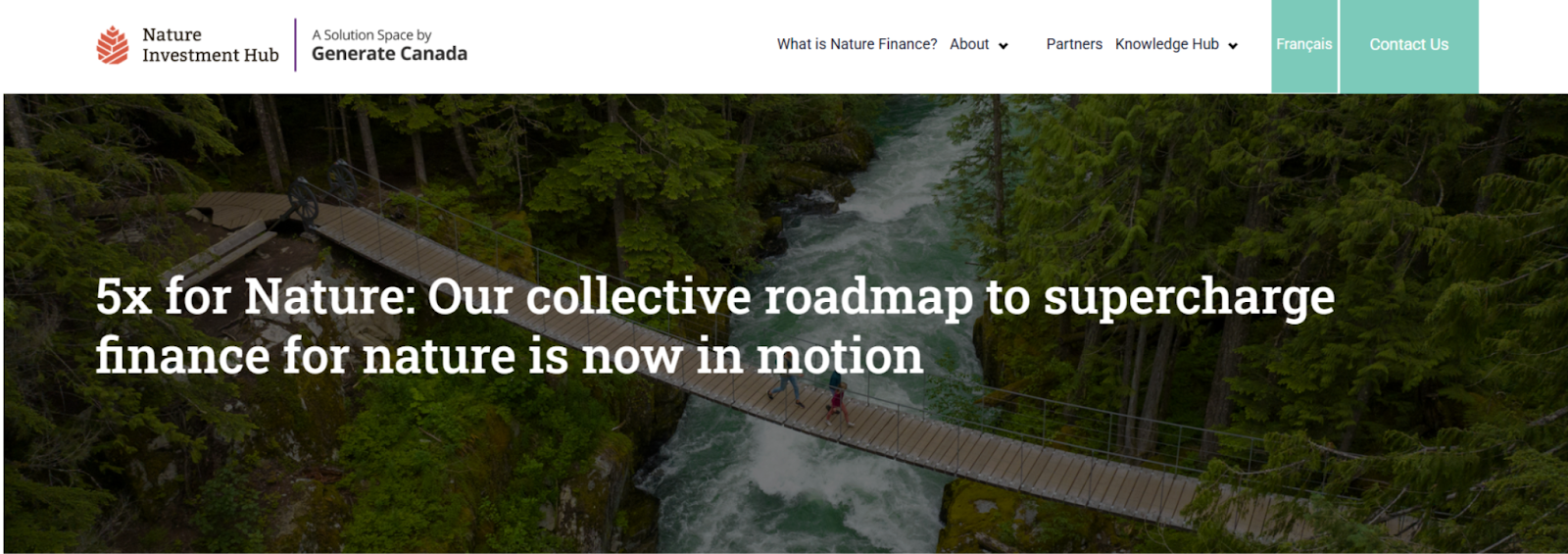
As highlighted above, due to our policy environment and land ownership realities, the Canadian nature finance context is unique and many international examples are not readily applicable here. The 5X for Nature Roadmap will present actionable solutions to accelerate domestic capital allocation to nature, in both the near and longer term. The 5x refers to our current funding gap, with an estimated five fold increase annually needed for nature investment to meet national biodiversity targets. The strategies that will be identified in the roadmap have emerged from a series of engagements with our network partners and the Canadian nature finance ecosystem as a whole, to highlight the most promising pathways and financial instruments to catalyze action and investment.
Q. You’re also piloting innovative financial mechanisms, such as crop insurance models that de-risk greener farming practices. Can you share what these demonstration projects are revealing about aligning incentives for farmers, insurers, and investors?
We have partnered with Farmers for Climate Solutions and the Smart Prosperity Institute on a research project that is exploring the feasibility of a Beneficial Management Practice (BMP) Insurance product in Canada.
This project seeks to address the risks farmers face when trialing new practices that ultimately help them build on-farm resilience, reducing their overall risk from extreme weather events and market shocks.
The project, which includes on farm pilots, underscores that financial incentives are often essential to help farmers adopt and sustain BMPs over time. In Canada, much of the agricultural insurance market is publicly administered through provincial insurers, but there’s interest from private sector insurers who recognize both the risks that climate change poses to their portfolios and the opportunity to reward practices that build resilience within the sector.
There are examples of these types of financial tools in other jurisdictions. In Australia, WTW's Nitrogen Risk Insurance covers losses producers may face when reducing nitrogen applications. Similarly, the US Post Application Coverage Endorsement (PACE) covers farmers if they experience a yield loss from split-nitrogen application.
Tech for nature can play a critical role in monitoring and quantifying ecological outcomes, providing the data that underpins the actuarial foundations of these insurance and investment mechanisms. It also presents an opportunity to streamline data reporting and reduce administrative burden producers face in participating in programs.
Q. What does “Canadian market nuance” mean in this context, and how might these locally adapted solutions inform global conversations on nature finance?
Two of the most common global strategies to generate revenue for nature are through carbon credits and sustainable resource management (e.g. forestry) that include land transactions. Generating credits requires additionality, and real asset transactions require the ability to own, buy, and sell property. A significant proportion of Canada, particularly in the north, are intact landscapes (no additionality by the carbon definition) and where the vast majority of land (90%) is public and cannot be owned, and so neither of these conditions apply.
There are specific cases and regional policies that enable some transactions to take place, but vast carbon-rich intact landscapes in the Boreal forest and peatlands in particular, hold globally significant carbon sinks and we currently lack financial incentives to keep it in the ground. These landscapes are also frequently Indigenous lands, where Indigenous stewardship is what has kept ecosystems functional. At the Hub, we wish to see financial models that reward proactive stewardship rather than a system that is contingent on ecosystems being degraded or threatened before they qualify for financing.
Project Finance for Permanence (PFPs) that center Indigenous leadership while using blended finance to support conservation and economic development over large scales are one attempt to facilitate revenue generation alongside sustainable financing strategies for nature stewardship. Protecting what we have rather than trying to rebuild after the fact is prudent economically as well as ecologically, and we could collectively benefit from considering other creative solutions to reward stewardship in other parts of the world.

Image Credits: Unsplash
Collaboration and the Global Nature Tech Ecosystem
Q. How do you see opportunities for collaboration between the Nature Investment Hub and the Nature Tech Collective’s global network, particularly around data standards, decision tools, or investor literacy?
We welcome the opportunity to serve as a connector between the global network and those in Canada who are advancing nature tech solutions, as well as Indigenous-led standards and tools that support this work.
As we pilot Canada’s first Nature Finance Bootcamp, we see meaningful opportunities for two-way learning—bringing examples from outside Canada into the curriculum where appropriate, and sharing Canadian innovations with global peers. We also invite the NTC network to watch for our annual investor survey, which may highlight opportunities for nature tech to address gaps and seize emerging opportunities.
For anyone interested in CANZA’s Environmental Outcomes Marketplace, we would be happy to facilitate an introduction to colleagues leading that work.
Q. What kind of partnerships are you most keen to explore through the Nature Tech Collective?
As a Nature Tech Connector, we are excited about being a bridge-builder within the NTC community.
We look forward to sharing the work NTC members are advancing globally with the Hub network, and to ensure that innovative solutions emerging from Canada are on the radar of NTC members. For example, the work of Nationsfirst (referred to earlier) or those projects supported by our partner Bloom Impact Capital (which operates the Bloom Local Food Fund), an impact investment firm focused on nature tech within sustainable food systems in southern Ontario and Quebec.
We also see real opportunity to identify and activate spaces for shared learning and collaboration across our networks through webinars or other online events.
Given our market-building mandate, we are also keen to connect with financial institutions and allocators to better understand how nature tech supports the building of business cases and influences decision-making.
Reflections and Lessons Learned
Q. What has been the most rewarding or surprising insight since you took on the role of Managing Director?
The depth, richness and promise of Indigenous-led conservation and the associated financing needed is without a doubt, the aspect of this agenda that I am most excited about. My learning journey on these aspects, along with the Hub team, has been both sobering and humbling. My biggest takeaway for doing this work in a good way here in Canada is understanding the materiality and primacy of clarity on land rights and jurisdiction for incenting investment for nature.
Q. What’s been most challenging about bridging finance, policy, and technology, and what advice would you give to others building similar ecosystems?
Our domestic environment in Canada is gearing up for fiscal austerity. These conditions tend to centre risk aversion, and in an emerging, nascent market like nature finance this can mean a reluctance to invest time, energy and resources on cross-sector collaboration. Our persistent challenge remains keeping the financial materiality of nature impacts top of mind for capital allocators, and ensuring that the nature projects we do advance generate inclusive benefits for all, especially Indigenous people.
Q. Looking ahead, what does success for the Nature Investment Hub look like by 2030?
A thriving, inclusive nature finance market that has closed our 20bn financing gap for conservation, stewardship and restoration.
Get Involved
Q. Where can people learn more about the Nature Investment Hub or connect to collaborate?
Explore our website at natureinvestmenthub.ca. We share resources, research, and insights through our Knowledge Hub.
To stay informed about news, funding opportunities, and events, subscribe to our newsletter and follow us on LinkedIn.
For general inquiries, contact info@natureinvestmenthub.ca. To explore partnership opportunities, reach out to Courtney Kehoe, Director of Partner Engagement, at ckehoe@natureinvestmenthub.ca.
