Nature Tech Market Intelligence Report: Insights from The Heat Climate Tech Festival, Oxford 2025
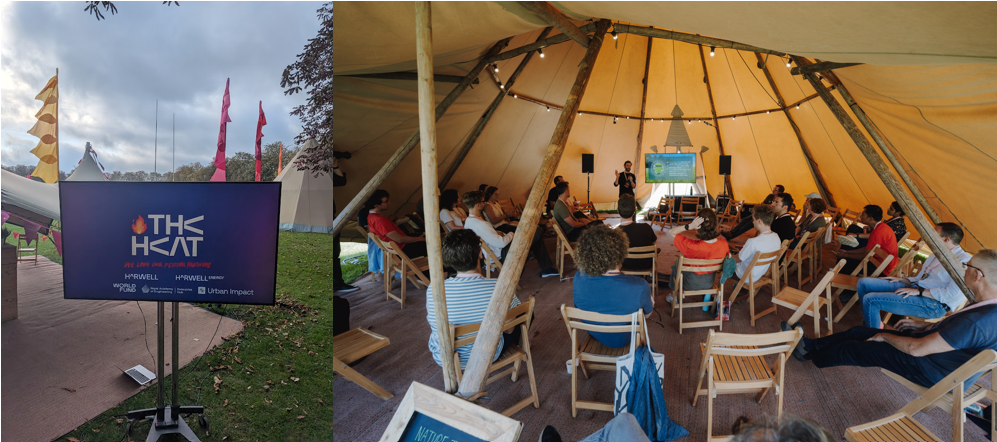
Image Credits: Ben Hart, Nattergal
The Nature Tech tent at The Heat Climate Tech Festival in Oxford convened leading innovators, scientists, project developers, investors, and technology providers to examine the rapidly evolving landscape of nature markets. The event featured a comprehensive lineup, including Conservation International, Carbon Rewild, Nature Metrics, Rhizocore, Treeconomy, Credit Nature, Stabiliti.io, Kana Earth, and Nattergal, each presenting real-world case studies and deep insights into the intersection of technology, finance, and biodiversity conservation.
The below Nature Tech Market Intelligence Report captures the most important insights from the Nature Tech Stage. The report highlights the $700 billion biodiversity financing gap, the structural bottlenecks slowing market growth such as measurement challenges, lack of standardization, and investor confidence and the emerging solutions shaping this new asset class. From cutting-edge MRV technologies like eDNA and bioacoustics to innovative financial models and digital platforms, the report provides a roadmap for making nature restoration investable at scale.
Session Insights & Case Studies
Nature Tech & Finance | Conservation International
"It's critical that finance flows to the people doing the on-the-ground work, the communities, Indigenous peoples, and local stakeholders stewarding lands and seas, restoring ecosystems, and implementing regenerative practices. Tech and AI can help make biodiversity outcomes more easily measurable and verifiable, helping to build trust and promote investment." ~ Carly Batist, Conservation International
Carly Batist underscored the estimated $700 billion annual global biodiversity financing gap and the persistent challenge of generating credible, decision-ready biodiversity metrics that can support investment. She shared how Conservation International is piloting different technology stacks to meet varied biodiversity MRV (Monitoring, Reporting, and Verification) needs, including in Yaguas National Park, Peru and other priority CI landscapes. Carly highlighted the cost-rigor trade-off as a recurring hurdle: monitoring approaches need to be affordable and operational at scale, but also scientifically robust enough to earn stakeholder and investor confidence.
Bioacoustics in Biodiversity Monitoring | Carbon Rewild
"Bioacoustic monitoring is the method of identifying and measuring the presence of species and ecosystems through sound. And sound is information. It's all around us. But how can we harness it?" ~ Stefan Zeeman, Carbon Rewild
Carbon Rewild's acoustic platform deploys networks of passive recorders to capture continuous sound data for months. AI models analyse these recordings to identify birds, bats, and small mammals, with human verification ensuring accuracy. In a recent UK rewilding project, their technology detected rare bat species and documented increased species richness post-restoration. This scalable, repeatable approach delivers robust, verifiable biodiversity data, crucial for generating carbon and biodiversity credits.
eDNA and Nature as an Asset Class | Nature Metrics & PlanetaryX
"We really need that quantitative stuff so we can actually measure performance. eDNA is the CSI of the nature world." ~ Joe Huddart, Nature Metrics
Nature Metrics' eDNA kits have been deployed in river restoration projects across the UK, identifying over 50 fish species per river, including elusive or invasive species. In one project, eDNA revealed a previously undetected population of endangered fish, guiding targeted conservation. Bart Schoonbaert of PlanetaryX explored the complexities of ownership, valuation, and standardisation, highlighting how nature differs from traditional asset classes: "Treating nature as an asset class reframes it from an externality to a recognised source of long-duration value that underpins economic performance though valuation and standardization remain complex."
Fungal Biotech & Remote Sensing | Rhizocore & Treeconomy
"Fungi have enabled $54 trillion worth of industry... Our aim is to discover, protect and restore the fungal kingdom of life which is fundamentally understudied and we're going to do it commercially." ~ Jack Hooper, Rhizocore
Fungal inoculants have been shown to increase tree biomass by 60% over 10 years, and Rhizocore's locally-adapted fungal pellets boosted tree growth by up to 13x in the first 12 months on an upland moor site.
Treeconomy's Sherwood Intelligence platform integrates satellite, drone, and ground data to create digital twins of restoration sites. As Harry Grocott put it: "If we can combine really great ecosystems, really great technology, then we can actually get nature restoration to a point at which it's very dull, very boring, and we can actually get them into pension funds, and if they're in pension funds, then there's loads and loads of money going into nature restoration."
Nature Market Integrity & Technology | Credit Nature
"A single universal metric for everything is probably not the right answer. But certainly there are categories of metrics that can be applied in certain contexts." ~ Cain Blythe, Credit Nature
Credit Nature's digital platform standardises project creation, embeds verification workflows, and tracks data provenance to ensure transparency and investor confidence. The Broughton Sanctuary project (607 hectares) generates carbon offsets, biodiversity net gain units, and nature credits through coordinated restoration. As Cain Blythe noted: "The combination of having a BNG Nature credit, with future carbon is a massive attraction for the investors and that way you can diversify your portfolio."
Market Infrastructure & Capital Flows | Stabiliti.io, Kana Earth, Nattergal
"There's currently no scalable infrastructure that allows everyday spending and institutional capital to flow reliably into nature. We see Stabiliti sitting in the middle, designing the rails that make that possible." ~ Will Foulkes, Stabiliti
Stabiliti is building the commercial and data infrastructure that enables money to move into nature restoration at scale. Its "green margin" model allows retailers and brands to embed small, automatic contributions into everyday transactions, creating predictable, repeatable funding streams for biodiversity and landscape recovery projects. Through a live pilot with a leading UK supermarket group, Stabiliti is demonstrating how this model can scale across thousands of stores.
Kana Earth acts as a digital backbone, enabling pension funds and asset managers to allocate capital to diversified portfolios of nature-based projects. As Andy Creak noted: "Currently this is about 0.2% of that 3 trillion. Coming up to 3% you can do the maths."
Nattergal manages three major restoration sites in southern and eastern England, generating biodiversity net gain units and voluntary carbon credits. "We believe that nature recovery needs to be investable because otherwise the private sector isn't going to join in with the amount of investment that we need to ultimately bend the curve on biodiversity loss." ~ Matt Hay, Nattergal
Listen to the Podcast: Closing the $700 Billion Biodiversity Gap
For a deeper dive into the conversation, tune into the podcast episode "Closing the $700 Billion Biodiversity Gap ~ Nature Tech". This discussion brings together key insights from the festival to unpack the financing challenge, explore breakthrough technologies, and share practical steps for mobilising capital into nature recovery.
The Nature Tech Market Intelligence Report was produced by Ben Hart of Nattergal, based on insights from The Heat Climate Tech Festival, Oxford, September 2025.