
The Nordic Paradox: How GIST Impact and Storebrand mapped the biodiversity footprint of 100 Nordic companies
Overview
In 2025, GIST Impact and Storebrand Asset Management published an analysis of the 100 largest listed companies across Norway, Sweden, Denmark, Finland and Iceland. The goal was to assess how these companies interact with nature, across impacts, dependencies, sensitive locations and social factors, using the TNFD LEAP framework.
Nordic companies are generally considered leaders on environmental governance. The data confirmed they outperform the global benchmark: their combined biodiversity impact is 42% lower than that of the Nature Action 100 companies. But the trend told a different story. Since 2017, their nature-related pressures have grown by roughly 1% per year. Growth has not been decoupled from nature impact.
The report, titled ‘Integrating Nature Data Into Investment Decisions’, has since been cited by TNFD as a reference case study.
42% lower biodiversity impact than the Nature Action 100 global benchmark, yet nature pressures have grown ~1% per year since 2017.
>70% of the portfolio's total biodiversity footprint comes from manufacturing, which represents just over half of its market value.
Why this is hard
Measuring nature risk across a large investment portfolio involves data from many different sources, corporate disclosures, satellite imagery, on-the-ground biodiversity records, that do not come in a standard format. The scientific metrics used to quantify biodiversity loss are not familiar to most investment teams. And nature impact is driven by multiple pressures at once: water use, land conversion, nitrogen and phosphorus pollution, greenhouse gas emissions. Looking at any one of them in isolation gives an incomplete picture.
A common response across the finance sector has been to wait for better data. GIST Impact and Storebrand both took the view that the data available today is sufficient to start. The Nordic 100 study was built to demonstrate that.
One approach in practice
GIST Impact draws on three types of data. The first is corporate disclosure data, tracked across more than 20,000 listed companies globally, covering over 500 indicators per company with records going back eight to ten years. The second is on-the-ground biodiversity data from NGO partnerships, including IBAT (a consortium of UNEP-WCMC, Conservation International, Birdlife International and IUCN), Global Canopy, and the Natural History Museum. The third is satellite imagery, processed at 100-metre resolution globally, used to track land use change over time and verify asset locations.
For the Nordic 100 study, companies were selected using TNFD LEAP criteria, benchmarked against the Nature Action 100 list. The analysis covered all four TNFD dimensions: sensitive locations, impacts, dependencies and social factors.
Biodiversity impact was calculated using the Potentially Disappeared Fraction of species (PDF), a scientific metric that has been in use since the mid-1990s. GIST Impact uses the open-source LC Impact model, which converts pressures across greenhouse gas emissions, water consumption, nitrogen, phosphorus and land use change into a single figure. That figure represents the likelihood that species in a given area will not be able to survive.
PDF values are expressed in scientific notation, which most investment professionals find difficult to work with. To make the results usable, GIST Impact also calculated Land Conversion Equivalents (LCE). This translates the combined biodiversity impact into an equivalent land area: the size of land that would need to be cleared to bare earth to produce the same effect. A company with an LCE of five square kilometres has not necessarily cleared any land. It means the total of all its pressures, water, emissions, pollution, land use, is equivalent in impact to clearing five square kilometres.
The analysis also mapped company assets against indigenous land classifications. Two companies in the portfolio had 47 assets operating in Category 1A areas, zones where no business activity should take place. Storebrand has a strict policy of excluding companies that compete with indigenous land rights. These findings fed directly into portfolio decisions.
47 assets belonging to two portfolio companies found operating in Category 1A indigenous protected areas.
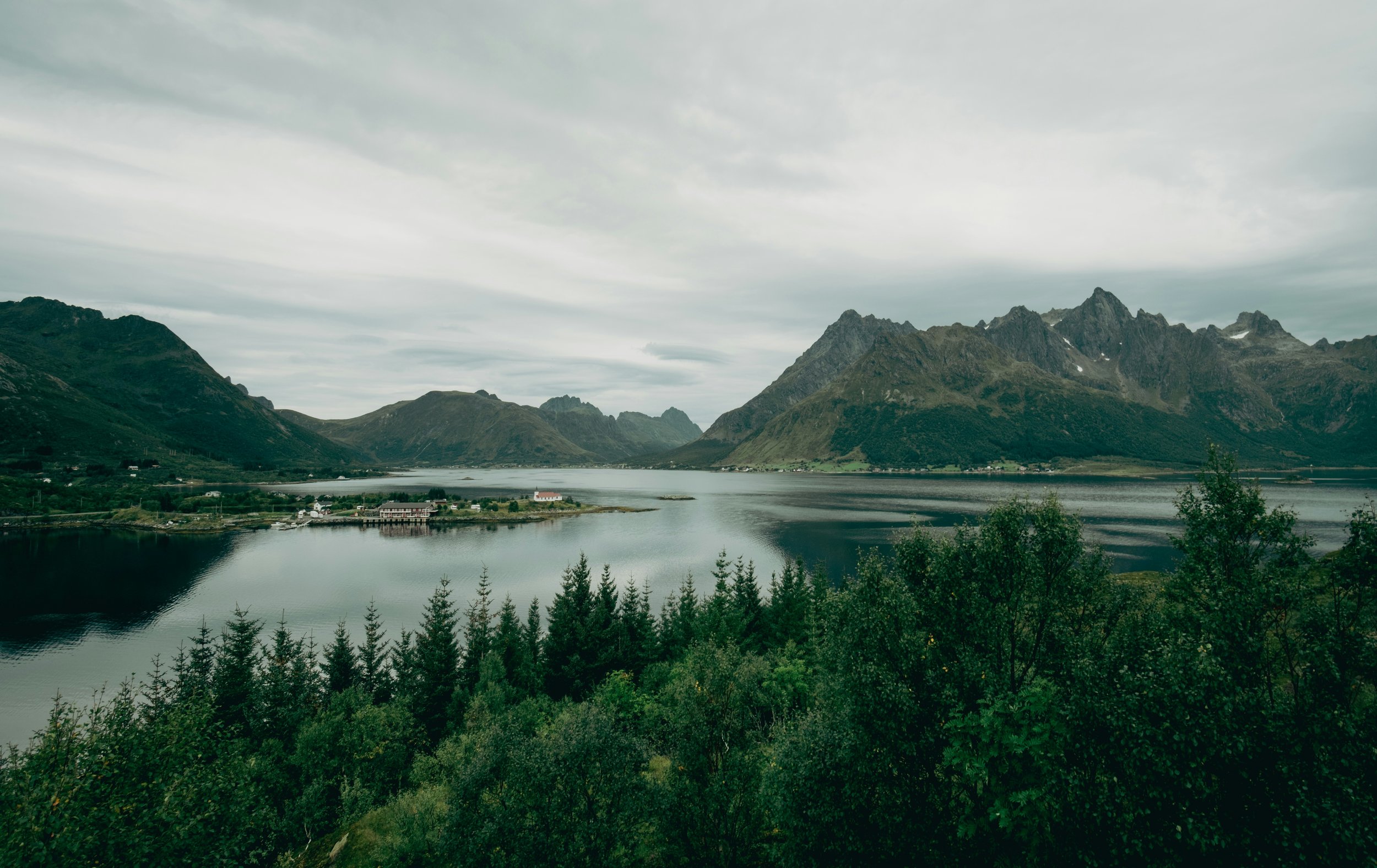
Image Credits: Unsplash
What this enables, and where it falls short
The study gave Storebrand a quantitative basis for integrating nature into investment decisions. It identified which sectors and companies carry the most exposure, which required direct engagement, and which triggered exclusion based on existing policy.
One of the clearer findings was on water. More than half of the manufacturing sites in the portfolio are located in regions already experiencing drought. For a sector that accounts for over 70% of the portfolio's biodiversity footprint, that is a financial exposure as much as an environmental one.
The analysis also showed that land use is not the main driver of nature impact for most large companies outside primary industries. For manufacturing, logistics and energy companies, water consumption and nitrogen and phosphorus outputs are more significant. This matters for how investors frame risk.
The analysis has limits. Asset-level data is still incomplete in places. GIST Impact can locate and classify a company's facilities, but does not always know the production volume at a given site or how central it is to the company's operations. A facility listed as manufacturing could be a primary production plant or a secondary processing unit. That distinction affects how much weight to give it in the analysis. Improving asset-level detail is an active area of work.
When satellite data shows forest loss near a company's assets, that is treated as a signal for investigation, not as direct evidence that the company caused the loss.
AI is used to process data at scale and to verify asset classifications using satellite imagery. It has reduced manual work significantly. The energy and water use associated with AI is something the team is aware of, given the nature of the work.
What others can take from this
For most large companies outside agriculture and extractives, water, nitrogen and phosphorus drive more biodiversity impact than land conversion. An analysis that looks only at carbon or land use will miss a significant share of the risk.
Making metrics usable is part of the work. PDF in scientific notation will not be picked up by investment teams. Translating it into something like Land Conversion Equivalents does not weaken the methodology, it makes it accessible.
Sufficient data exists to start. The Nordic 100 study used corporate disclosures, NGO datasets, and satellite imagery that were already available. Norway's sovereign wealth fund NBIM has run a similar analysis across a portfolio of around 8,500 companies. The data question is largely settled.
Engagement comes before divestment. The primary output of this kind of analysis is a list of companies to talk to, with specific evidence to ground those conversations. Divestment is an option of last resort when companies do not respond over time.
Case Classification
Modeling · Market Pressures · Biodiversity Footprinting · Natural Capital Accounting · Portfolio Risk Assessment · AI and Machine Learning · Earth Observation Analytics · GIS · Nordic Region · Terrestrial · Freshwater · Marine
